
Introduction
Impulsivity is a tendency to act without thinking through the results. It can manifest in various ways, including substance abuse, reckless spending, and engaging in risky behaviours. In its simplest form, impulsive behaviour is an action that aims at immediate gratification of needs and drives. Be that a negative emotion like anger or the compulsion to act on something dangerous (such as buying impulsively on credits or problem drinking), we label someone as impulsive when they manifest the inability to hold, delay, or channelise gratification positively.
In today’s fast-paced world, impulsive behaviour is becoming increasingly common, with individuals often acting on their impulses without considering the long-term consequences. This blog post will explore the definition of impulsive behaviour, the reasons for its prevalence, and the various techniques people use to manage it, including mindfulness, cognitive-behavioural therapy, and medication.
Impulsive behaviour is not a mental disorder in itself until it reaches a point where other conditions such as ADHD, Kleptomania, Depressive Disorders, or other co-occurring disorders crop up as a result of impulsivity. Nevertheless, if left unmanaged, a lack of impulse control can be a potential risk to the individual’s mental health.
What are the benefits of tackling impulsive behaviour with online learning?
Many people choose online courses to learn more about impulsivity and how to help themselves eliminate it. The flexibility and structured nature of the online modules, together with affordability and lifetime access to materials, make them the first choice for many.
Some of the benefits of tackling impulsive behaviour with online learning include the following –
-
Flexibility
Online learning allows individuals to learn at their own pace and on their schedule, which can be particularly beneficial for those who struggle with impulsivity. With online learning, individuals can take breaks and return to the material when they feel more focused and less impulsive.
-
Accessibility
Online learning is accessible from anywhere with an internet connection, making it easier for individuals to access the resources they need to overcome impulsive behaviour. This can be especially helpful for those living in rural areas or with limited access to mental health resources.
-
Anonymity
Online learning can provide a sense of anonymity, which can be helpful for individuals who feel embarrassed or ashamed about their impulsive behaviour. This anonymity can make it easier for individuals to seek help and support without fear of judgment.
-
Personalisation
Online learning platforms can personalise the learning experience to match the individual’s needs and learning style. This can be particularly helpful for those who struggle with impulsivity because it allows them to learn in a way that works best for them.
-
Support
Many online learning platforms provide access to online communities and support groups, which can be a valuable resource for individuals struggling with impulsive behaviour. These communities offer a sense of belonging and support, which helps individuals feel less isolated and more motivated to overcome their impulsive behaviour.
Professional intervention for impulsivity
Professional intervention or therapy is often required for managing impulsivity because impulsive behaviour can have significant negative consequences on an individual’s life and can be challenging to overcome. For example, impulsive behaviour can often be linked to underlying mental health conditions, such as attention-deficit/hyperactivity disorder (ADHD), bipolar disorder, or borderline personality disorder. These conditions require specialised treatment, including therapy and medication, to manage symptoms and prevent impulsive behaviours.
Benefits of choosing therapy for managing impulses
-
Therapy digs into the root cause
Therapy can help individuals with impulse control disorders understand the underlying causes of their behaviour. For example, impulsive behaviour may be linked to past traumas, emotional distress, or underlying mental health conditions. By addressing these underlying issues, therapy can help individuals gain insight into their behaviour and develop strategies for managing it.
-
Promotes improved coping mechanisms
Therapy can teach individuals with impulse control disorders coping mechanisms to help them manage their behaviour. These may include mindfulness, relaxation, or cognitive-behavioural strategies to help individuals identify triggers and develop new behaviour patterns.
-
Helps in improving relationships
Impulse control disorders can affect personal relationships, causing conflict and tension. Therapy can help individuals learn to communicate more effectively, set boundaries, and repair damaged relationships, improving social functioning and quality of life.
-
Addresses co-occurring disorders
Many individuals with impulse control disorders may also have co-occurring mental health conditions like anxiety or depression. Therapy can help address these conditions, which may be contributing to impulsive behaviour.
-
Prevents negative consequences
Overall, therapy can effectively manage impulse control disorders by addressing underlying issues, teaching coping mechanisms, improving relationships, addressing co-occurring conditions, and preventing negative consequences. By seeking therapy, individuals can take an important step toward managing their impulses and leading healthier, more fulfilling life.
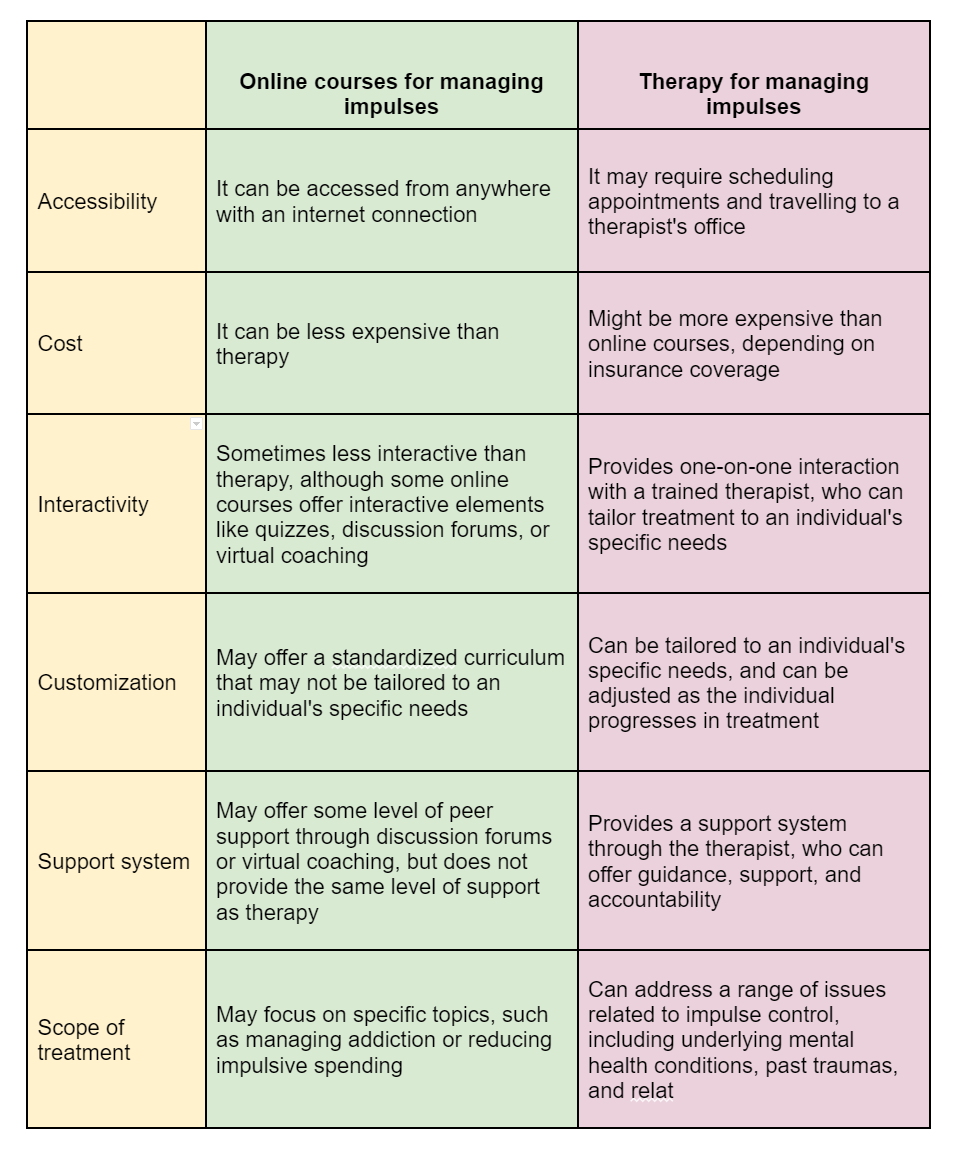
Managing Impulses – Online Courses vs Therapy
Conclusion
Professional intervention either as an online course or individual therapy sessions can provide individuals with a support system to help them overcome their impulsive behaviour. Attending support groups, working with a coach or mentor, or seeking help from a therapist or psychiatrist. These professionals can provide guidance, support, and accountability, which can be critical in managing impulsivity and avoiding relapses.
Impulsivity is an online hub where you can access expert help and support whenever needed. Developed by trained professionals and designed to match your own pace, our online impulsivity courses will help you better manage impulsive behaviours, like overeating, for good.
Explore all our impulsivity courses here.
Developed by a team led by Dr Yuliya Richard (a clinical psychologist specialising in Impulsivity), our courses use scientifically proven strategies to help you understand and overcome the specific impulsive behaviours affecting everyday life.
If you want to take charge of your life and manage your Impulsivity for good, we can help. Impulsivity offers a range of online courses that can guide you towards a healthier and happier life. So take our quick impulsivity test now to see if we can help!
References
- Korte, K. J., Allan, N. P., & Schmidt, N. B. (2016). The efficacy of cognitive behavioural therapy for reducing impulsivity: A meta-analysis. Clinical Psychology Review, 49, 24-34.
- Herman-Stahl, M. A., Krebs, C. P., Kroutil, L. A., & Heller, D. C. (2007). Risk and protective factors for methamphetamine use and nonmedical use of prescription stimulants among young adults aged 18 to 25. Addictive Behaviors, 32(5), 1003-1015.
- Anestis, M. D., Selby, E. A., Fink, E. L., & Joiner Jr, T. E. (2007). The multifaceted role of distress tolerance in dysregulated eating behaviours. International Journal of Eating Disorders, 40(8), 718-726.
- Snorrason, I., Berlin, G. S., & Davies, G. E. (2019). The effects of mindfulness-based interventions for reducing impulsivity: A systematic review and meta-analysis. Journal of Contextual Behavioral Science, 13, 63-75.