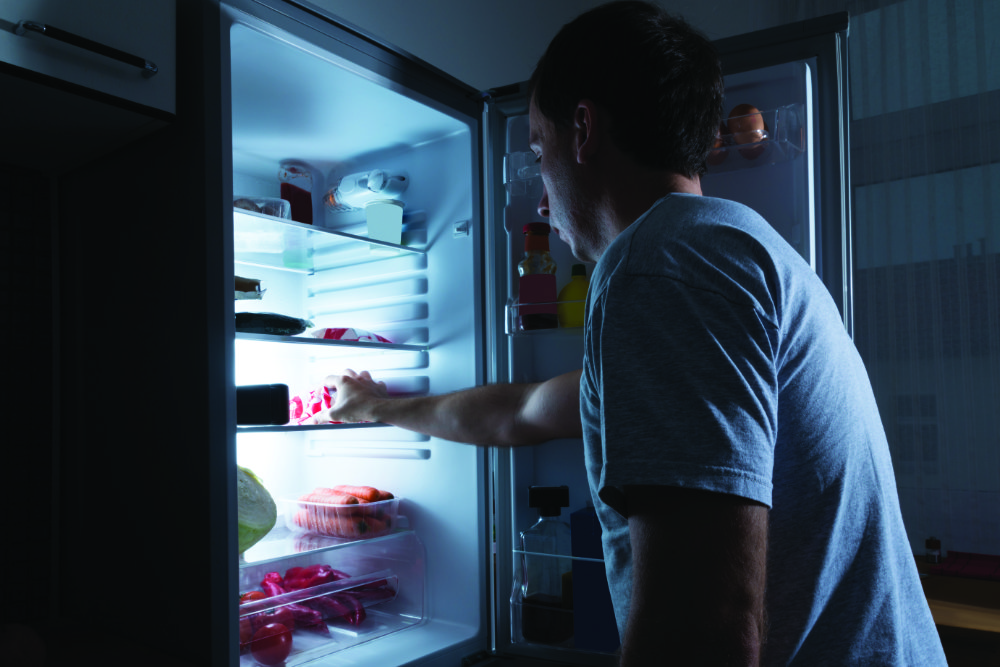
I don’t remember ever having a late-night assignment without a chocolate bar by my side. It’s not easy to stay focused when you’re tired and sleep-deprived, and I know I’m not the only one. At 10:30 p.m. the brain bargains: just a bite, just one episode, just one “Add to Cart.” By 11:15, the wrapper’s empty, the next episode autoplays, or the order confirmation pings. For some it’s food; for others it’s “five minutes” of scrolling that becomes an hour, or a quick purchase that dents tomorrow’s budget. Many people struggle and if you are high in impulsivity trait you will struggle even more.
Why nights amplify urges
- Sleep loss tilts choice toward “now.” Short sleep heightens emotional reactivity, shifts valuation toward immediate rewards, and weakens prefrontal control (Ben Simon & Walker, 2020; Krause et al., 2017).
- Circadian timing matters. Eveningness and later circadian phase track with higher impulsivity in youth and young adults (AASM, 2025).
- Time-discounting grows when we’re fatigued. At night the future feels abstract, so near rewards win (Wang et al., 2021).
- Frictionless environments accelerate slips. One-click pay, saved cards, open snacks, and infinite scroll make the wrong action effortless (Feinberg, 1986; Banker et al., 2021).
- Light and media keep arousal high. Expert guidance recommends dimmer, warmer light and less interactive media before bed (Brown et al., 2022; Islam et al., 2025).
Bottom line: nights stack the deck. The fix is not willpower. It’s state management plus conditions by design.
Step 1 — Downshift your state before deciding
10-minute nightly reset
- Breathe 4-4-6 for ~90 s, repeat 5–6 cycles.
- Warm shower/face wash to mark wind-down.
- Lights down and Night Shift; lamps over overheads.
- Protein + fiber snack if hungry.
- Dock the phone away from bed/couch.
Rule: No money/food/social decisions until this reset is done.
Step 2 — Add friction so the wrong move is slower
Money
- Remove autofill cards.
- Turn on a 24-hour cart-hold; hide “Buy Now.”
- Put shopping apps in a folder called “Decide Tomorrow.”
Eating
- Pre-plate evening snacks at 5 p.m.; tape the rest shut.
- Store snacks high/opaque/away; put protein/fruit visible.
Scrolling
- App timer 15 minutes with auto-lock.
- Phone charges outside the bedroom; use a cheap alarm clock.
- TV remote on a shelf so you must stand to fetch it.
Choice architecture shifts behavior without lectures.
Step 3 — Pre-commit while calm
- Money: freeze one credit card in a zipper bag of water; keep a low-limit card accessible.
- Screens: Do Not Disturb 9:30 p.m.–6:30 a.m.; whitelist only essentials.
- Accountability: text a night buddy at 9:15, “Running the plan now.”
Defaults and pre-commitment carry you through the dip.
Step 4 — Run implementation intentions (copy these)
Spending
- If it’s after 9 p.m. and I want to buy, then I move to Wishlist and decide at 9 a.m.
- If checkout is open, then I say aloud: “$80 now = $0 Friday; wait = +$80 Friday.”
Eating
- If I want seconds, then I set a 10-minute timer and drink water first.
- If I snack on the couch, then I plate it at the bench.
Scrolling
- If I open social after 9:30, then I start a 15-minute timer and keep the phone on the table, not in my hand.
- If the timer ends, then I dock the phone and pick up a paper book.
Three night playbooks
Late-night spending
- Run the reset. 2) Wishlist, not Buy. 3) Speak the explicit-zero trade-off. 4) Screenshot the wishlist as proof you can wait.
Evening grazing
- Pre-plate at 5 p.m.; tape the rest. 2) Eat one plate at the bench. 3) Seconds require timer + water + 10 push-ups; if you still want it, plate it.
Doom-scroll loop
- App timer 15; phone on table. 2) At timer end, dock phone → read two pages. 3) If urge returns, repeat once; then lights out.
One-week experiment
- Pick one domain.
- Nightly checklist: reset ▢ friction ▢ script ▢
- Count “future wins” each night. Target ≥4 this week. If you hit 6, add a second domain next week.
Gain self-control and rebuild trust — at home, at your pace
Struggling with explosive anger at home or work? Buying things you don’t need, doom-scrolling past midnight, or eating and drinking to take the edge off? Acting before you think and chasing the quick hit? That pattern points to impulsivity—a trainable driver of unwanted habits and strained relationships.
Our online courses at www.impulsivity.com help you:
- Lower reactivity fast so late-night, high-cost choices drop.
- Build real self-control with 10-minute tools you can use today.
- Improve relationships by replacing blow-ups and shutdowns with clear, calm communication.
- Break binge loops in spending, eating, drinking, and scrolling by redesigning triggers and routines.
What you get
Short, evidence-based video lessons. Step-by-step worksheets. Private, self-paced access you can revisit anytime. Ongoing support via webinars and resources.
Who it’s for
People who feel “hot” in the evenings. Anyone stuck in cycles of anger, compulsive shopping, binge eating/drinking, or chronic procrastination. Partners and professionals wanting skills that stick.
Prove it to yourself
Not sure if impulsivity is the core issue? Take our free, confidential 4-minute test to see whether impulsive behavior is driving your anger, conflict, or loss of control. Start your first module and run your nightly plan tonight.
Begin now at www.impulsivity.com. Design beats willpower.
References (APA)
American Academy of Sleep Medicine (AASM). (2025). Circadian preference is associated with impulsivity in adolescents [Press release]. SLEEP Meeting.
Banker, S., Lin, S., & Kuo, E. (2021). Neural mechanisms of credit card spending. Scientific Reports, 11, 19822. https://doi.org/10.
Ben Simon, E., & Walker, M. P. (2020). Sleep loss and the socio-emotional brain. Trends in Cognitive Sciences, 24(6), 435–450. https://doi.org/10.
Brown, T. M., Brainard, G. C., Cajochen, C., Czeisler, C. A., Hanifin, J. P., Lockley, S. W., … Lucas, R. J. (2022). Recommendations for daytime, evening, and nighttime indoor light exposure. PLOS Biology, 20(3), e3001571. https://doi.org/10.
Feinberg, R. A. (1986). Credit cards as spending-facilitating stimuli: A conditioning interpretation. Journal of Consumer Research, 13(3), 348–356.
Islam, S. M. S., et al. (2025). Exploring the link between smartphone use and sleep quality: A systematic review. Sleep and Vigilance, 9(1), e70002. https://doi.org/10.
Johnson, E. J., & Goldstein, D. (2004). Defaults and donation decisions. Transplantation, 78(12), 1713–1716.
Krause, A. J., et al. (2017). The sleep-deprived human brain. Nature Reviews Neuroscience, 18, 404–418. https://doi.org/10.
Thaler, R. H., & Sunstein, C. R. (2008). Nudge: Improving decisions about health, wealth, and happiness. Yale University Press.
Wang, H., et al. (2021). Temporal discounting when outcomes are experienced in the moment. PLOS ONE, 16(5), e0251480. https://doi.org/10.
Note: Evidence on specific blue-light filters is mixed, but convergent guidance supports dimmer, warmer light and reducing stimulating media before bedtime to improve sleep and next-day self-control.